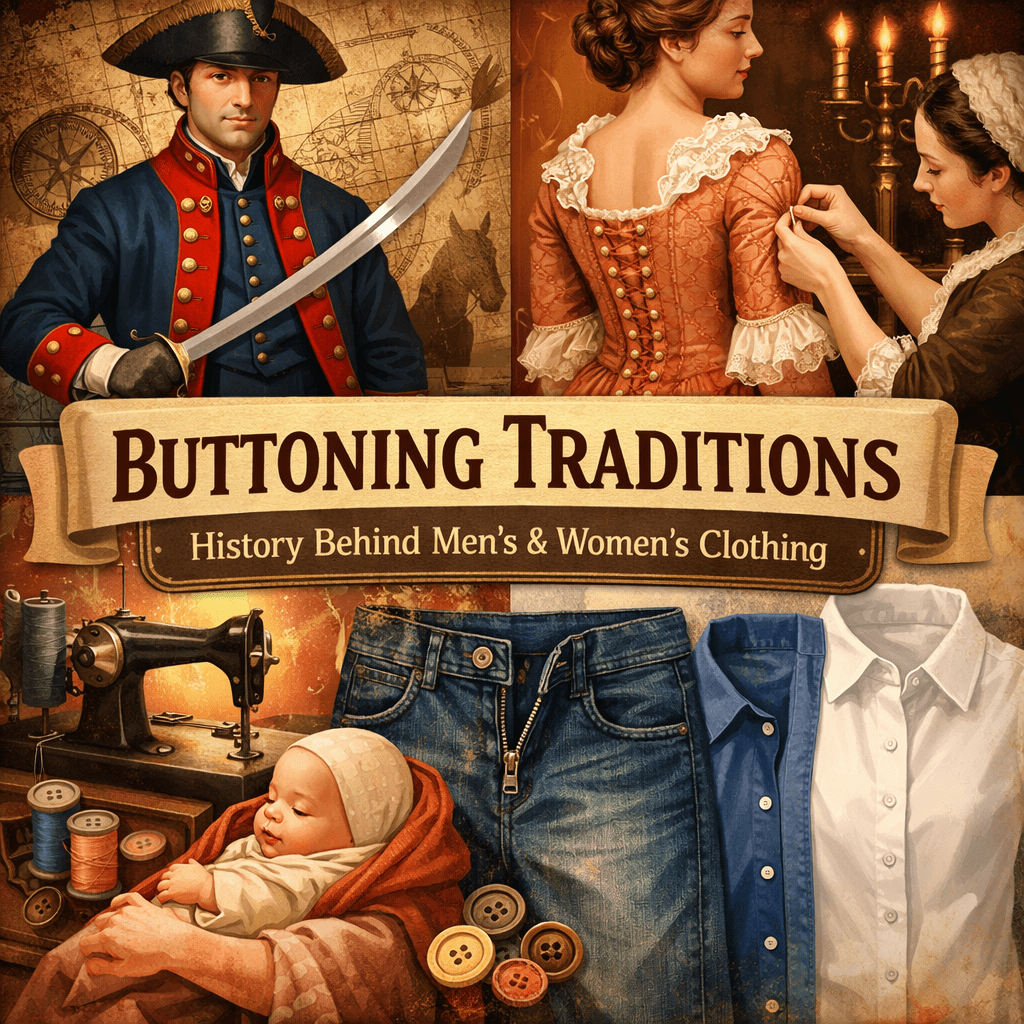
The surprisingly tangled history behind buttons, zippers, and who closes what from which direction
If you’ve ever put on a shirt in low light and thought, “Why does this feel backward?” — congratulations, you’ve stumbled into one of fashion’s longest‑running quirks. Men’s and women’s clothing fasten on opposite sides, and it’s not a modern invention. It’s a centuries‑old habit that stuck around long after the original reasons faded.
Today we’re taking a fun, curious dive into why your shirt buttons left‑over‑right (if you’re a guy) or right‑over‑left (if you’re a woman), and why jeans, jackets, coats, and even some zippers follow the same rule.
Spoiler: it’s about swords, servants, babies, horses, and marketing — not necessarily in that order.
🗡️ 1. Men’s Buttons: A Legacy of Weapons and Dominant Hands
For men, the fastening rule goes like this:
Buttons on the right side, buttonholes on the left.
This dates back to when clothing was designed with combat in mind. Most men were right‑handed, and that shaped everything:
- A right‑handed man could draw a sword more easily if his coat opened left‑to‑right.
- The overlap protected the chest better during a right‑handed strike.
- Military uniforms standardized the practice, and civilian fashion followed.
Once the military adopts a design, it tends to become “the way things are done.” Even after swords disappeared, the button placement stayed.
👑 2. Women’s Buttons: A Story of Servants and Social Status
Women’s clothing flips the rule:
Buttons on the left side, buttonholes on the right.
Why? Because historically, wealthy women didn’t dress themselves.
In the 17th–19th centuries, upper‑class women wore elaborate garments with layers, stays, hooks, and buttons. Dressing was a whole event — and it was usually done by a maid standing in front of them.
For a right‑handed maid facing the wearer, left‑side buttons were easier to fasten. Clothing makers catered to the wealthy first, and the convention trickled down to everyone else.
So women’s buttons ended up on the opposite side not because women needed it, but because someone else did.
🐎 3. Riding Habits and Early Fashion Engineering
Another historical nudge came from horseback riding.
Women’s riding habits were designed to drape a certain way when sitting side‑saddle — a posture that placed the rider’s legs together on one side of the horse. Button placement helped the garment fall smoothly and prevented wind from catching the fabric.
It’s a small detail, but fashion loves consistency. Once a rule is established, it tends to stick.
👶 4. Nursing and Practicality (The Soft Theory)
There’s a gentler theory too: early clothing makers may have placed women’s buttons on the left to make nursing easier.
Holding a baby in the left arm (common for right‑handed mothers) leaves the right hand free to unbutton the garment. A left‑side closure makes that motion slightly easier.
Is this the main reason? Probably not. But it likely reinforced the existing pattern.
🧵 5. Industrialization: When Habits Became Law
Once mass production arrived in the 1800s, factories needed standardization.
Instead of tailoring each garment individually, manufacturers followed the established norms:
- Men’s shirts: buttons on the right
- Women’s blouses: buttons on the left
It became a manufacturing rule, not a functional one. And once a rule gets baked into industrial machinery and patterns, it becomes tradition.
👖 6. What About Jeans and Zippers?
Jeans follow the same logic — but with a twist.
Men’s jeans typically have the fly opening left‑to‑right. Women’s jeans often mimic the same pattern, but not always. Modern women’s denim sometimes flips the direction for aesthetic reasons or simply because the brand wants consistency across styles.
Zippers on jackets usually follow the traditional button rule, but athletic wear and unisex brands often ignore it entirely.
In other words: the closer you get to modern fashion, the more the rules blur.
🛍️ 7. The Modern Reason: Marketing and Identity
Today, the fastening difference is mostly about signaling.
It tells you instantly:
- This is a men’s shirt
- This is a women’s blouse
It’s a branding cue, a fit cue, and a way for retailers to categorize clothing quickly. The original reasons — swords, servants, horses — are long gone, but the habit remains because it helps the fashion industry organize itself.
✨ The Fun Takeaway
The reason men and women fasten their clothes differently is a mash‑up of:
- medieval combat
- right‑handed maids
- horseback riding
- early nursing habits
- industrial standardization
- and modern marketing
It’s history stitched into every shirt you own.
Next time you button up, you’re participating in a centuries‑old tradition — one that started for reasons that have nothing to do with your morning routine, but everything to do with how humans lived, fought, worked, and dressed long before zippers existed.


Hey there — I’m Jon. This is Moteventure, my corner of the internet where music, movies, lists, and life all collide. Glad you’re here.