Inspired by Carl’s curb‑climbing parking in Netflix’s “Dept. Q”
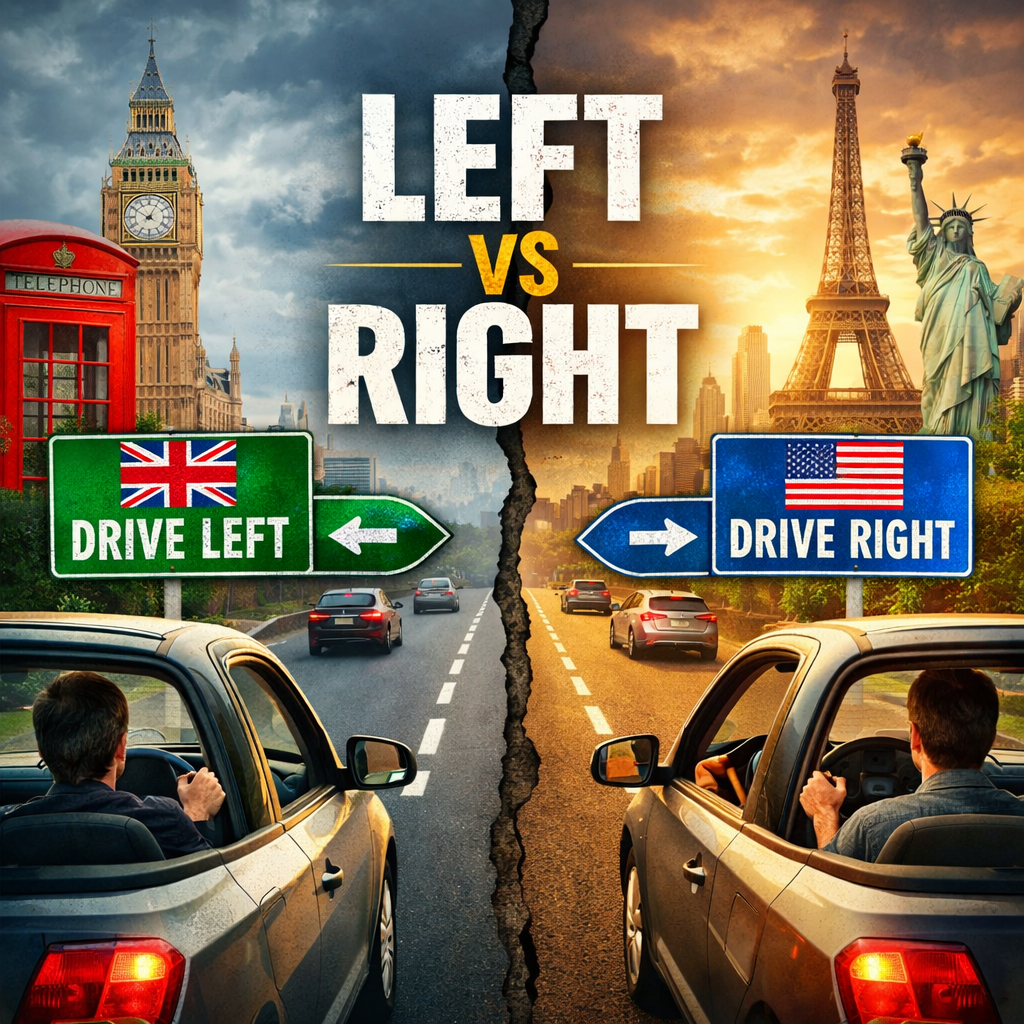
While watching Netflix’s Dept. Q, one detail kept stealing the spotlight from the crime scenes: Carl’s parking. Every time he pulls in, he hops the curb like it’s part of the standard operating procedure. And because he’s an Englishman working in Edinburgh, the visual naturally highlights one of the United Kingdom’s most distinctive habits — driving on the left side of the road while sitting on the right side of the car.
It’s the opposite of how driving works in the United States, and it raises a surprisingly deep question:
Why does the world split between left‑side and right‑side driving, and how did these two systems evolve?
The answer winds through centuries of history, empire, and a few unexpected characters.
🏇 Before Cars, There Were Horses — And Swords
The origins of left‑side travel stretch back to the age of horseback riding. For most of human history, travelers rode or walked rather than drove, and because the majority of people are right‑handed, staying to the left made practical sense.
- A traveler’s right hand stayed free to draw a sword or greet someone.
- Mounting and dismounting a horse was easier and safer on the left.
- Passing strangers head‑on felt more controlled when the dominant hand faced them.
England adopted this pattern early and never abandoned it. Scotland followed the same tradition. Long before cars existed, the left side of the road was simply the safer, more logical choice.
🇫🇷 Napoleon: The Man Who Flipped Europe
The major shift toward right‑side travel came later, thanks to Napoleon Bonaparte. His armies marched on the right, and wherever he conquered, right‑side travel became law. Some historians suggest it was symbolic — aristocrats traditionally rode on the left, so Napoleon pushed everyone to the right as a way of flattening social hierarchy.
Countries under his influence switched. Countries he never conquered, like England, stayed left.
This single historical divide created the foundation for today’s global split.
🇺🇸 America Chooses the Right — Thanks to Wagons
Across the Atlantic, the United States developed its own logic. Early American freight wagons were enormous, pulled by multiple horses, and lacked a driver’s seat. The driver sat on the left rear horse so the right hand could control the whip.
Sitting on the left made it easier to judge oncoming traffic if everyone stayed to the right side of the road. By the late 1700s, right‑side travel was becoming standard. When Henry Ford introduced the Model T with the steering wheel on the left, the pattern became permanent.
America’s driving system wasn’t inspired by Europe — it was inspired by horses.
🌍 The Global Patchwork We Live With Today
Today, about 65% of the world drives on the right, and 35% drives on the left. The split follows history more than geography.
Left‑Side Countries (mostly influenced by Britain)
- United Kingdom
- Scotland
- Ireland
- Australia
- New Zealand
- India
- Japan (for samurai‑era reasons, not British ones)
- South Africa
- Several Caribbean nations
Right‑Side Countries (Napoleon or American influence)
- Most of Europe
- United States
- Canada
- China
- Russia
- South America
It’s a map of empires, trade routes, and traditions that stuck.
🚘 Why Drivers Sit on Opposite Sides of the Car
The logic behind steering wheel placement is simple:
- Drive on the left → steering wheel on the right This puts the driver closer to the centerline for better visibility.
- Drive on the right → steering wheel on the left Same reasoning, reversed.
Carl’s setup in Dept. Q — right‑side steering, left‑side driving — fits perfectly within the UK’s long‑standing tradition.
🔄 Can Countries Switch Sides? Yes — But It’s Complicated
A few countries have switched sides, usually for political or economic reasons.
The most famous example: Sweden, 1967 — “H Day” (Högertrafikomläggningen) At 5:00 AM on September 3rd, Sweden switched from left‑side to right‑side driving. Overnight. New signs, new intersections, new bus doors, new traffic patterns. Against all odds, the transition went smoothly.
But most countries avoid switching because the cost and disruption are enormous.
✨ The Takeaway
The world drives on two different sides because of:
- medieval sword etiquette
- Napoleon’s empire
- wagon drivers with whips
- early automotive design
- and centuries of “this is how we’ve always done it”
It’s a piece of history hiding in plain sight every time a car pulls onto the road — or every time Carl hops a curb in Dept. Q.
😊 Now It’s Your Turn
If you’ve ever noticed a tiny habit in a show or movie that sent you down a historical rabbit hole, share it — those moments make the best stories.


Hey there — I’m Jon. This is Moteventure, my corner of the internet where music, movies, lists, and life all collide. Glad you’re here.