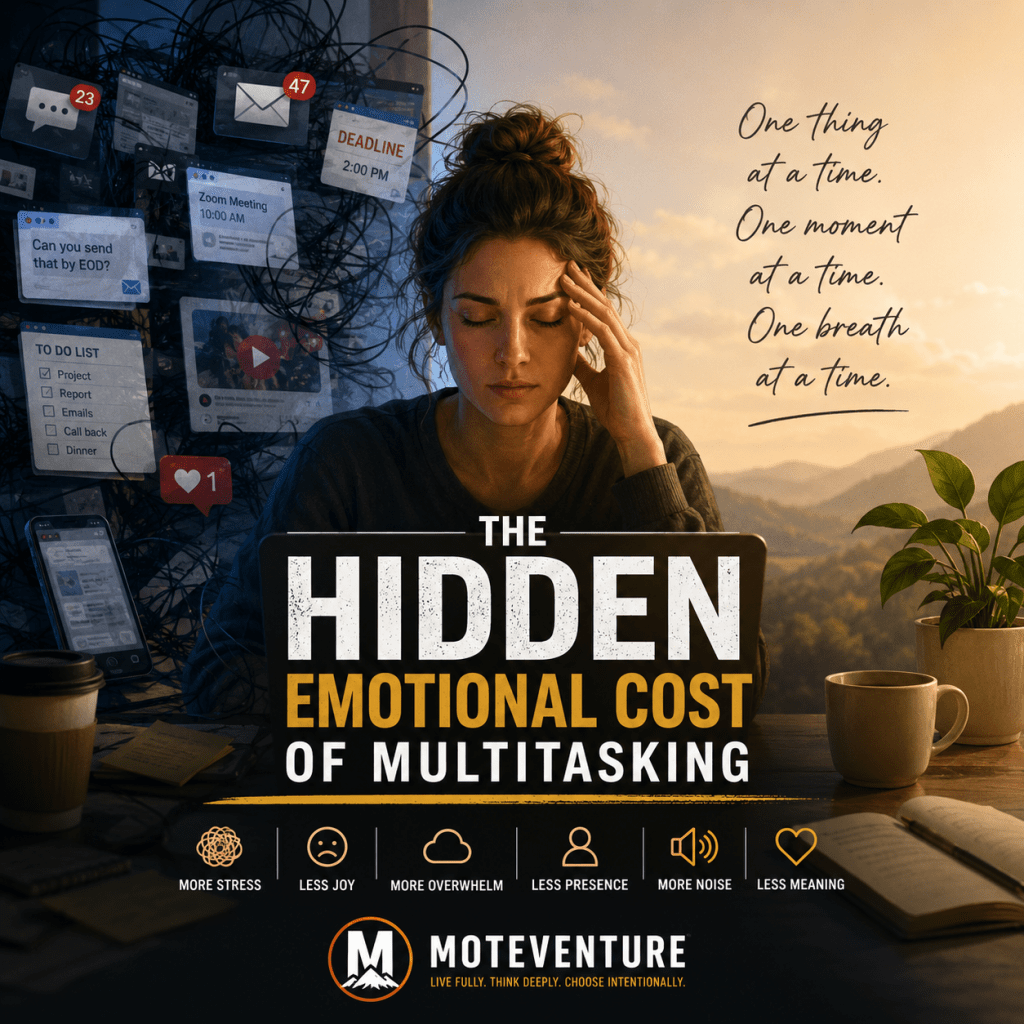
We live in a world that worships the multitasker. The person juggling five conversations, three deadlines, two screens, and one rapidly cooling cup of coffee. The person who can answer emails while on a Zoom call while mentally planning dinner while scrolling TikTok during the loading screens.
It feels productive. It feels efficient. It feels like the only way to keep up.
But underneath that frantic choreography is a quieter truth — multitasking isn’t just a mental strain. It’s an emotional one. And most of us don’t realize how much it’s costing us until we finally stop.
The Myth of “Doing More”
Multitasking sells the illusion of momentum. You feel busy, so you assume you’re moving forward. But the brain doesn’t actually multitask — it task switches, rapidly flipping between activities like a light switch having a nervous breakdown.
Every switch drains a little energy. A little focus. A little patience.
By the end of the day, you’re exhausted, but you can’t point to anything meaningful you actually finished. It’s like running on a treadmill: lots of motion, zero distance.
And that gap — between effort and accomplishment — creates a subtle emotional ache. A sense of falling behind even when you’re sprinting.
The Emotional Whiplash of Constant Switching
When you jump between tasks, your emotions jump with you.
One moment you’re answering a serious email. The next you’re scrolling something funny. Then you’re back to something stressful. Then something inspiring. Then something annoying.
Your brain never gets a chance to settle. Your emotions never get a chance to land.
It’s like flipping TV channels every five seconds — eventually, you forget what you were even watching. That emotional fragmentation builds up, leaving you feeling scattered, irritable, and weirdly disconnected from your own day.
The Slow Erosion of Presence
Multitasking steals the one thing modern life already gives us too little of: presence.
When you’re doing three things at once, you’re not in any of them. You’re half-listening, half-working, half-resting — which means you’re never fully experiencing anything.
You miss the small joys. You miss the subtle cues. You miss the moments that make life feel textured and real.
Presence is where meaning lives. Multitasking quietly drains it away.
The Stress of Perpetual Incompleteness
There’s a unique kind of stress that comes from having too many tabs open — literally and mentally.
Every unfinished task becomes a tiny emotional weight. Every notification becomes a micro‑tension. Every “I’ll get back to that” becomes a loose thread tugging at your attention.
By the end of the day, you’re carrying a dozen unresolved mental cliffhangers. Your brain stays in “open loop” mode, unable to fully rest because it’s still tracking everything you didn’t finish.
It’s not laziness. It’s not lack of discipline. It’s cognitive overload — and it feels like failure even when it’s not.
The Loss of Deep Satisfaction
There’s a special kind of joy that comes from finishing something with your full attention. A sense of completion. A sense of clarity. A sense of “I did that.”
Multitasking robs you of that feeling.
When everything is done in fragments, nothing feels whole. When everything is rushed, nothing feels meaningful. When everything is split, nothing feels like yours.
Deep satisfaction requires deep focus — and multitasking keeps you skimming the surface of your own life.
Why We Keep Doing It Anyway
Because multitasking feels like control. It feels like competence. It feels like survival in a world that never slows down.
But the emotional cost is real: • more stress • less joy • more overwhelm • less presence • more noise • less meaning
And the worst part? We often blame ourselves for feeling this way, instead of recognizing the system we’re stuck in.
Closing Thoughts
Multitasking isn’t a moral failure — it’s a coping mechanism. A way to feel productive in a world that demands too much and rewards too little. But the emotional toll is undeniable. When we split our attention, we split our experience. When we divide our focus, we divide our peace.
The antidote isn’t perfection. It’s intention.
One thing at a time. One moment at a time. One breath at a time.
Your brain will thank you. Your emotions will thank you. Your life will feel a little more like something you’re living — not just managing.


Hey there — I’m Jon. This is Moteventure, my corner of the internet where music, movies, lists, and life all collide. Glad you’re here.