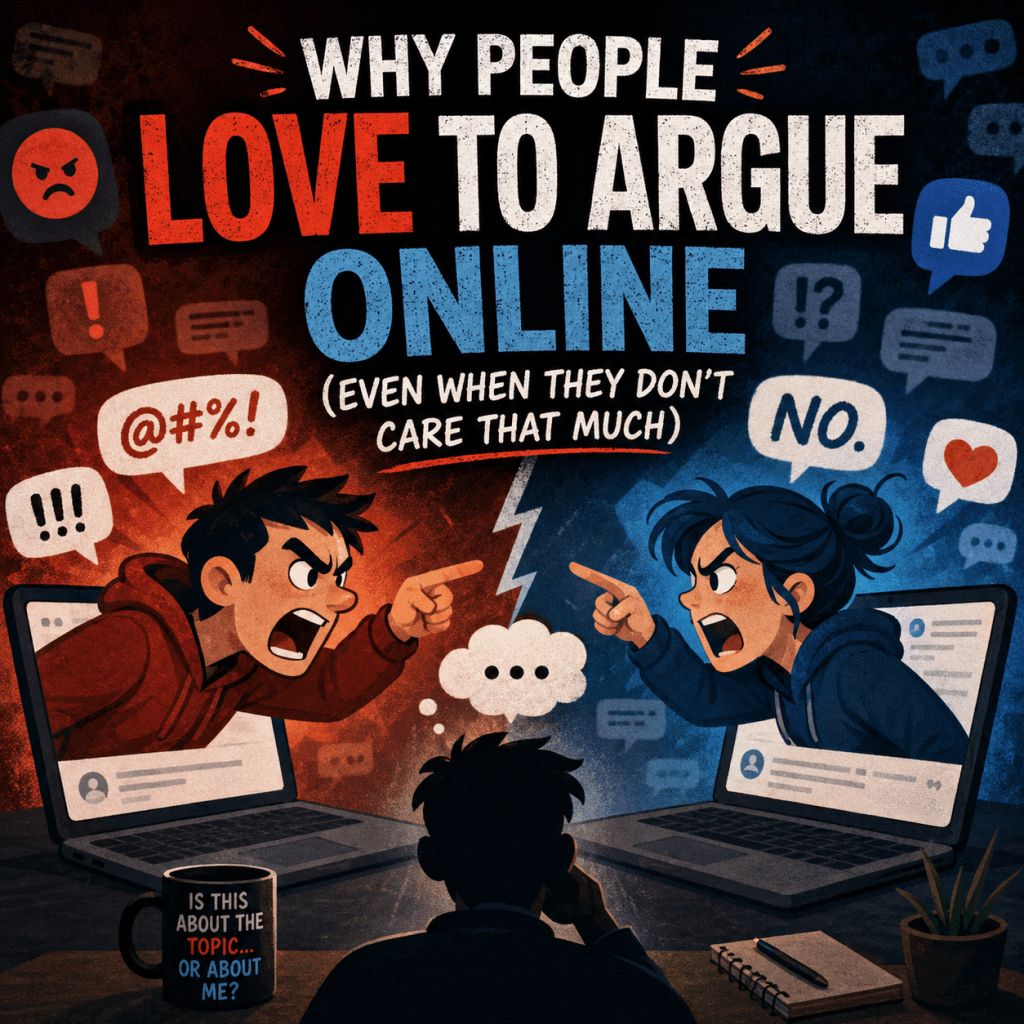
There’s a strange moment that happens to all of us: you’re scrolling, minding your own business, maybe sipping coffee, maybe procrastinating on something important, when suddenly you see a comment so baffling, so confidently wrong, so cosmically unhinged that your brain whispers, “Say something.”
And just like that, you’re in it — typing paragraphs to a stranger you will never meet, defending a hill you didn’t even know you lived on.
Why do we do this? Why do perfectly reasonable people become gladiators the moment a comment section opens its gates? Let’s dig into the psychology behind the world’s favorite digital pastime: arguing online.
The Internet Removes the Awkwardness of Real Life
In real life, most people avoid conflict. You don’t walk into a grocery store, see someone picking the wrong brand of cereal, and say, “Actually, that’s a terrible choice and here’s a 12‑point breakdown of why.”
But online? No eye contact. No tone of voice. No awkward silence. No social consequences.
It’s conflict without the discomfort — a frictionless arena where people can unleash opinions like confetti cannons.
The screen becomes a shield, and behind it, even the quietest person can become a philosopher‑warrior.
We’re Wired to Protect Our Identity
Every opinion we post online feels like a tiny extension of who we are. So when someone challenges it, it doesn’t feel like a disagreement — it feels like a threat.
Psychologists call this identity-protective cognition, which is a fancy way of saying:
“If you disagree with me, my brain thinks you’re attacking my entire personality.”
So we defend. Hard. Even when the topic is something we don’t actually care about, like whether pineapple belongs on pizza or which superhero could beat which other superhero in a fictional fight that will never happen.
It’s not about the topic. It’s about the self.
The Dopamine Hit of Being “Right”
Winning an argument online feels good — even if the victory is imaginary.
Every like, every “THIS,” every “Exactly!” is a tiny digital high-five. And high-fives are addictive.
The brain loves certainty. It loves being right. It loves validation. And the internet is a 24/7 casino of potential micro‑victories.
Even when we know we should walk away, the possibility of that next little dopamine hit keeps us in the ring.
Outrage Is Weirdly Entertaining
Let’s be honest: sometimes we argue online because it’s… fun.
There’s a reason reality TV thrives on conflict. There’s a reason people rubberneck at drama. There’s a reason comment sections feel like spectator sports.
Outrage is stimulating. It’s energizing. It’s a break from the monotony of daily life.
And the internet delivers it in endless supply — neatly packaged, algorithmically boosted, and ready for consumption.
The Illusion That We Can Change Someone’s Mind
Every online argument begins with a tiny spark of optimism:
“If I just explain this clearly enough, they’ll understand.”
But here’s the twist: people rarely change their minds in public. Admitting you’re wrong in front of strangers feels like losing face, so most people double down instead.
Still, we try. We write long explanations. We cite sources. We craft the perfect comeback.
Not because it works — but because it feels like it might.
Hope is a powerful motivator.
It Makes Us Feel Less Alone
This is the part nobody talks about.
Arguing online isn’t always about conflict. Sometimes it’s about connection.
When you find someone who agrees with you — someone who sees the world the way you do — it feels like a tiny moment of belonging. A tribe forming in real time.
Even the arguments themselves can create a sense of community. Shared frustration. Shared passion. Shared investment in something that, objectively, doesn’t matter at all.
It’s messy, but it’s human.
So… Why Do We Keep Doing It?
Because the internet is a mirror. It reflects our insecurities, our identities, our need for connection, our craving for validation, and our desire to be understood.
Arguing online isn’t just about being right. It’s about being seen.
And even though we know we should probably log off, breathe, and touch some grass, there’s something undeniably magnetic about the chaos of a comment section.
It’s flawed. It’s funny. It’s frustrating. It’s human nature with Wi‑Fi.
Closing Thoughts
At the end of the day, arguing online is less about conflict and more about psychology. It’s a digital stage where identity, emotion, curiosity, and connection collide. And while it’s easy to roll our eyes at the drama, it’s also a reminder that behind every username is a real person trying — in their own chaotic way — to matter.
So the next time you feel the urge to jump into a comment war, pause for a second. Ask yourself: Is this about the topic… or about me?
Either way, you’ll learn something — about the internet, or about yourself.


Hey there — I’m Jon. This is Moteventure, my corner of the internet where music, movies, lists, and life all collide. Glad you’re here.