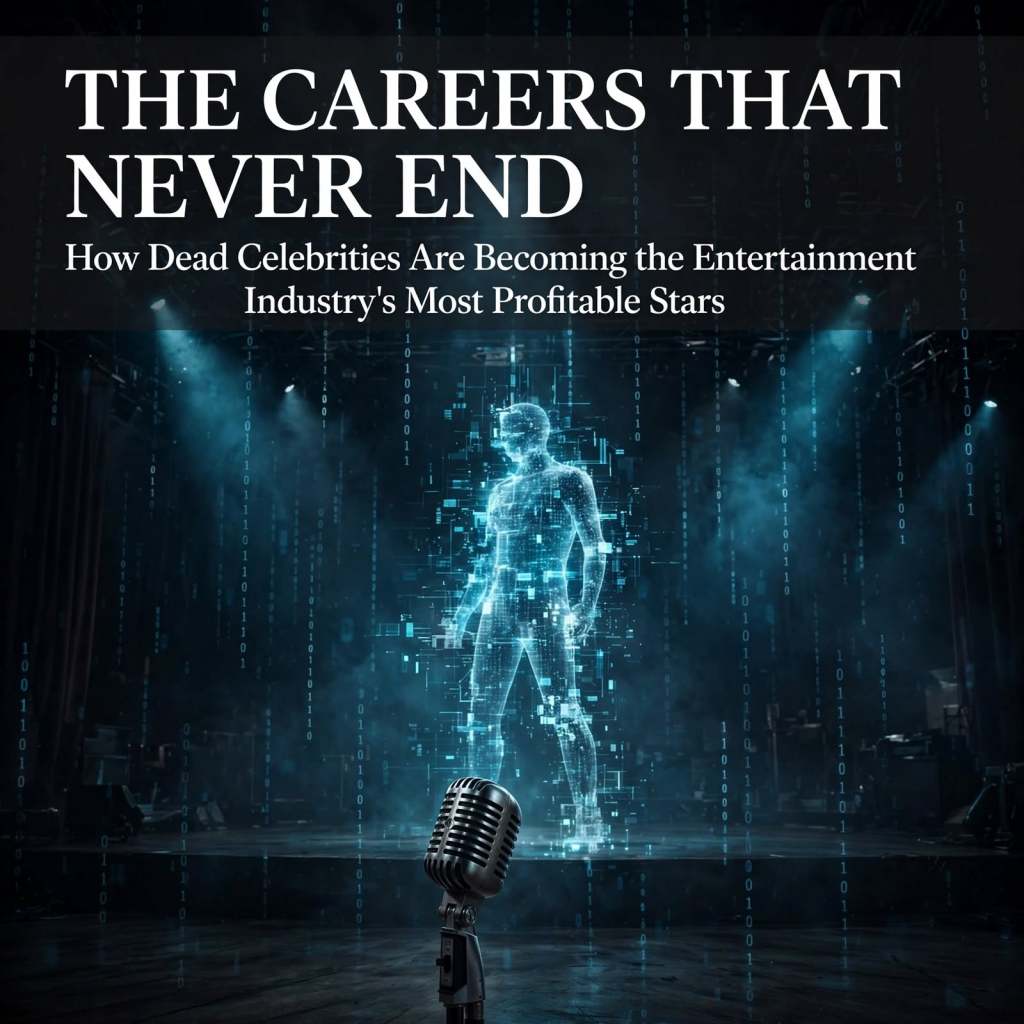
The modern entertainment economy has quietly entered a strange new era — one where Whitney Houston, Elvis Presley, Prince, Olivia Newton‑John, Kurt Cobain, Donna Summer, and dozens of other icons continue to “work” long after their deaths. Their likenesses appear in commercials, their voices narrate new content, and their digital avatars perform on stages they never physically stepped on.
This isn’t nostalgia — it’s business. And thanks to generative AI, estates and rights‑holders are now able to create entirely new performances, endorsements, and even conversations featuring artists who are no longer alive. The result is a booming “necro‑economy,” where death is not the end of a career but the beginning of its most profitable chapter.
Why Dead Celebrities Are More Valuable Than Ever
A Perfect Storm of Technology and Ownership
AI has made it possible to reconstruct a celebrity’s voice, face, and mannerisms with startling fidelity. Voice‑cloning platforms like Respeecher and ElevenLabs can rebuild a singer’s vocal tone from minutes of audio, while visual AI systems can generate photorealistic avatars from archival footage.
This means estates can now:
- Release new “songs” from artists who never recorded them
- Cast deceased actors in new films
- License digital likenesses for commercials, brand partnerships, or political messaging
- Create interactive “AI twins” that speak in the celebrity’s voice and style
The commercial appeal is obvious: dead celebrities don’t age, renegotiate contracts, or get embroiled in scandals. They are “safe,” controllable, and endlessly monetizable.
The Money Behind the Machine
The financial stakes are enormous.
- Michael Jackson’s estate earned $400 million in 2018 alone.
- Elvis Presley’s estate generates around $40 million per year.
- Marilyn Monroe’s likeness earns over $30 million annually, managed by Authentic Brands Group (ABG), which controls dozens of celebrity estates.
These estates function like corporations, curating the brand identity of the deceased and deciding what products, films, or endorsements their likeness should be attached to.
The New “Careers” of the Dead: Case Studies
Whitney Houston
Her estate has licensed her image for hologram tours and merchandise, raising questions about whether these performances honor her legacy or commodify her memory.
Elvis Presley
The 2024 ELVIS Act in Tennessee was passed specifically to protect Presley’s likeness from unauthorized AI replication — a sign of how valuable and vulnerable his digital identity has become.
Prince
Prince was famously protective of his image and music rights while alive. Yet posthumously, his estate faces pressure to monetize his vast archive — and AI now makes it possible to create “new” Prince songs he never approved.
Olivia Newton‑John
Her estate continues to license her music and image, but AI raises the possibility of generating new performances that she never recorded — a moral dilemma for an artist known for her authenticity.
Kurt Cobain
Cobain’s legacy is fiercely guarded, yet AI could theoretically generate new Nirvana songs or appearances. Would that honor his artistry or violate his ethos?
Donna Summer
As the Queen of Disco, her catalog remains lucrative — and AI could extend her career indefinitely, raising questions about consent and artistic intent.
The Ethical Fault Lines: Who Controls a Legacy?
1. Consent After Death
The biggest ethical challenge is simple: A deceased artist cannot consent to new performances.
Estates may authorize projects that contradict the artist’s values, beliefs, or personal boundaries. The BBC has reported cases where estates approved endorsements the deceased would likely have rejected.
2. Distorting or Rewriting Legacies
AI allows rights‑holders to reshape a celebrity’s identity:
- A singer could “perform” in genres they never embraced
- An actor could appear in films they would have refused
- A public figure could endorse products they opposed
This creates a future where a celebrity’s legacy is not preserved — it is manufactured.
3. Economic Harm to Living Artists
AI‑resurrected stars compete with living performers for roles, endorsements, and attention. As one legal analysis notes, resurrecting yesteryear’s icons may “disadvantage today’s newcomers,” reducing opportunities for emerging talent.
4. The Rise of “Deadbots”
AI companies are now creating conversational replicas (“deadbots”) that mimic a deceased person’s speech patterns and personality. This raises profound questions about dignity, grief, and exploitation.
5. Public Opinion Is Clear
A nationwide survey found that while people support family‑controlled memorial uses, they overwhelmingly reject commercial or political exploitation of digital remains — even by relatives.
The Legal Landscape: A Race to Catch Up
The NO FAKES Act
A proposed U.S. federal law aimed at regulating unauthorized digital replicas. It highlights the difficulty of defining post‑mortem rights in a world where AI can resurrect anyone.
State-Level Protections
California and Tennessee have enacted strong post‑mortem publicity laws, but protections vary widely across states. Some celebrities, like Robin Williams, have drafted estate plans to restrict digital use of their likeness for decades.
The Need for a New Framework
Legal scholars argue for a “tailored-default” system that:
- Allows memorial and educational uses
- Restricts commercial exploitation without explicit consent
- Applies to everyone, not just famous individuals
This approach aims to protect dignity while acknowledging technological realities.
The Future: AI Actors, Synthetic Albums, and Eternal Brands
We are rapidly approaching a world where:
- AI actors replace human performers
- Albums are released featuring artists who never sang a note
- Digital twins appear in films, commercials, and political ads
- Interactive versions of deceased celebrities become subscription services
- Estates function like studios, producing content indefinitely
The question is no longer whether this will happen — it already is. The Beatles’ 2023 release “Now and Then,” featuring AI‑reconstructed vocals from John Lennon, reached #1 in multiple countries.
So What Do We Owe the Dead?
At the heart of this debate is a simple moral question:
Does a person’s identity belong to them — or to whoever owns their rights after they’re gone?
If AI can resurrect anyone, then the boundaries between tribute, exploitation, and reinvention will only grow more blurred. The entertainment industry must decide whether it is preserving legacies or rewriting them for profit. And society must decide whether we are comfortable living in a world where the dead never truly rest — they just keep working.
A Final Thought
The careers of MIchael Jackson, Whitney Houston, Elvis Presley, Prince, Olivia Newton‑John, Kurt Cobain, Donna Summer, and countless others were defined by human creativity, vulnerability, and choice. AI can replicate their voices and faces — but it cannot replicate their agency.
As technology advances, the question becomes not what AI can do, but what we should allow it to do.
What Do You Think About All This?
The idea of celebrities working long after they’re gone hits everyone differently. Some people see it as a tribute. Others see it as exploitation. And plenty of us are still trying to figure out how we feel about AI resurrecting voices, faces, and performances that were never actually created by the artist.
I’d love to hear your take. Does this new era of digital immortality feel innovative, unsettling, inevitable… or something else entirely? Drop your thoughts in the comments — your perspective helps shape where conversations like this go next.
And if you’re enjoying these deep dives into culture, tech, and the strange corners of the entertainment world, make sure you’re subscribed to the Moteventure Blog so you never miss a post. Fresh stories, new ideas, and a whole lot of curiosity — delivered right to you.


Hey there — I’m Jon. This is Moteventure, my corner of the internet where music, movies, lists, and life all collide. Glad you’re here.