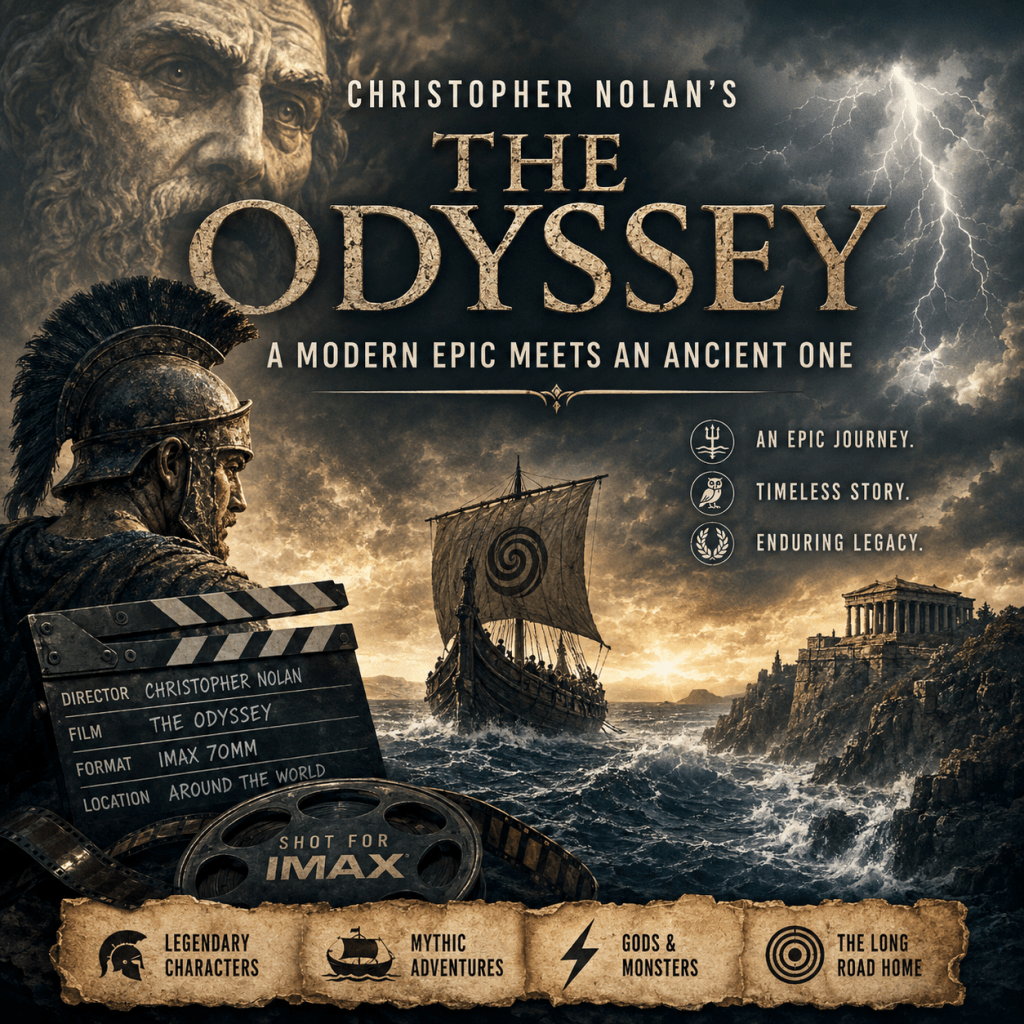
Christopher Nolan’s new film adaptation of The Odyssey isn’t just a blockbuster—it’s a cinematic expedition that mirrors the grit, grandeur, and mythic strangeness of Homer’s original poem. Shot across oceans, mountains, forests, and unforgiving weather, Nolan’s production pushed cast and crew to their limits, echoing Odysseus’ own trials.
Below is a deep dive into both the film and the ancient poem—its origins, characters, and the long cultural shadow it casts.
🎬 The Film: Nolan’s Odyssey in IMAX 70mm
Nolan’s The Odyssey is a 172-minute epic fantasy action film starring Matt Damon as Odysseus, Anne Hathaway as Penelope, Tom Holland as Telemachus, and Zendaya as Athena. It’s the most expensive project of Nolan’s career, shot entirely on IMAX 70mm and filmed across Morocco, Greece, Italy, Scotland, Iceland, and more—locations as rugged as the myth itself.
A Production as Grueling as the Journey Itself
Nolan and his team endured 91 days of filming across remote, punishing landscapes. Cast members hiked mountains just to reach shooting locations, battled sideways rain in Iceland, and filmed on boats until they were physically spent.
Matt Damon joked that each new country seemed harder than the last—Greece was brutal, Italy was no easier, and Iceland was a stormy nightmare. Nolan was right there with them, soaked, cold, and climbing every mountain.
Creative Liberties & Character Reimagining
Nolan’s adaptation reshapes several dynamics from the poem. For example, Telemachus—traditionally dismissive of his mother—is reimagined as the immature one, with Penelope asserting her authority and fire.
Nolan also grounds divine interventions in natural phenomena—thunder, lightning, earthquakes—reflecting how ancient Greeks interpreted the gods through the world around them.
Runtime & Reception
At 2 hours and 52 minutes, it’s Nolan’s second-longest film, trailing only Oppenheimer. Critics love it: 96% on Rotten Tomatoes and 97% on the Popcornmeter.
📜 The Poem: Homer’s Ancient Masterwork
Composed around the 8th century BC, The Odyssey is one of the oldest surviving works of Western literature. It follows Odysseus’ ten-year struggle to return home after the Trojan War, encountering monsters, gods, temptations, and shipwrecks along the way.
Origins & Oral Tradition
The poem emerged from oral storytelling traditions. Before written texts existed, bards performed the epic aloud, using formulaic phrases and repetition to aid memory. It wasn’t until centuries later that the poem was standardized into the 24-book version we know today.
Was Homer Real?
Homer is a mysterious figure—possibly a blind poet from Ionia, possibly a symbolic name for a tradition of storytellers. Scholars agree he shaped both The Iliad and The Odyssey, but details of his life remain elusive.
Key Themes
- Nostos (homecoming): Odysseus’ longing for Ithaca.
- Xenia (hospitality): A moral code tested repeatedly.
- Metis (cunning): Odysseus’ greatest weapon.
- Identity & disguise: Recognition scenes drive the narrative.
- Divine agency: Gods meddle, guide, and punish.
🧑🤝🧑 Major Characters: Ancient Bios & Film Counterparts
Odysseus (Matt Damon)
In the poem, Odysseus is “polytropos”—a man of many twists and turns, clever, adaptable, and morally complex. Translators debate whether he turns events or is turned by them. In Nolan’s film, he’s a haunted warrior grappling with trauma from the Trojan War.
Penelope (Anne Hathaway)
In Homer, Penelope is patient, clever, and loyal—fending off suitors for 20 years. Nolan gives her sharper edges, flipping the power dynamic with Telemachus and emphasizing her resilience.
Telemachus (Tom Holland)
The poem portrays him as young, insecure, and sometimes dismissive of his mother. The film reimagines him as immature but earnest, chastened by Penelope’s strength.
Athena (Zendaya)
In Homer, Athena is Odysseus’ divine protector—strategic, wise, and fiercely loyal. Nolan grounds her interventions in natural phenomena, blending myth with realism.
The Suitors (Robert Pattinson as Antinous)
In the poem, they are arrogant, gluttonous, and doomed. Nolan’s version intensifies their cruelty, making the final reckoning even more dramatic.
🌊 Why Nolan’s Film Works So Well
Nolan’s Odyssey succeeds because it embraces the poem’s mythic scale while making it emotionally immediate. He honors the source material—studying multiple translations, including Emily Wilson’s groundbreaking 2017 version—while crafting a story that feels modern, visceral, and cinematic.
The film blends:
- War drama
- Mythological fantasy
- Psychological thriller
- Family saga
- Adventure spectacle
Just like the poem itself.
🏛️ The Odyssey’s Enduring Legacy
For thousands of years, The Odyssey has shaped Western storytelling—from ancient Greek education to Renaissance literature to modern cinema. Its themes of homecoming, identity, resilience, and the struggle against fate remain timeless.
Nolan’s adaptation doesn’t replace Homer—it joins a long tradition of reinterpretations, each adding new layers to a story that refuses to fade.
Before You Sail Off…
If you’re enjoying this blend of myth, movies, and madness, don’t leave Ithaca without joining the crew. Subscribe to the Moteventure Blog and get fresh posts, reactions, music drops, behind‑the‑scenes chaos, and all the creative adventures delivered straight to your inbox.
Your next epic journey starts with one click.
✨ Closing Thoughts
Whether you’re watching Matt Damon battle a Cyclops in IMAX or reading Homer’s dactylic hexameter by lamplight, The Odyssey remains a tale of survival, wit, loyalty, and the long road home.
Nolan’s film is both a tribute and a transformation—an epic that respects its ancient roots while carving out its own place in cinematic history.


Hey there — I’m Jon. This is Moteventure, my corner of the internet where music, movies, lists, and life all collide. Glad you’re here.