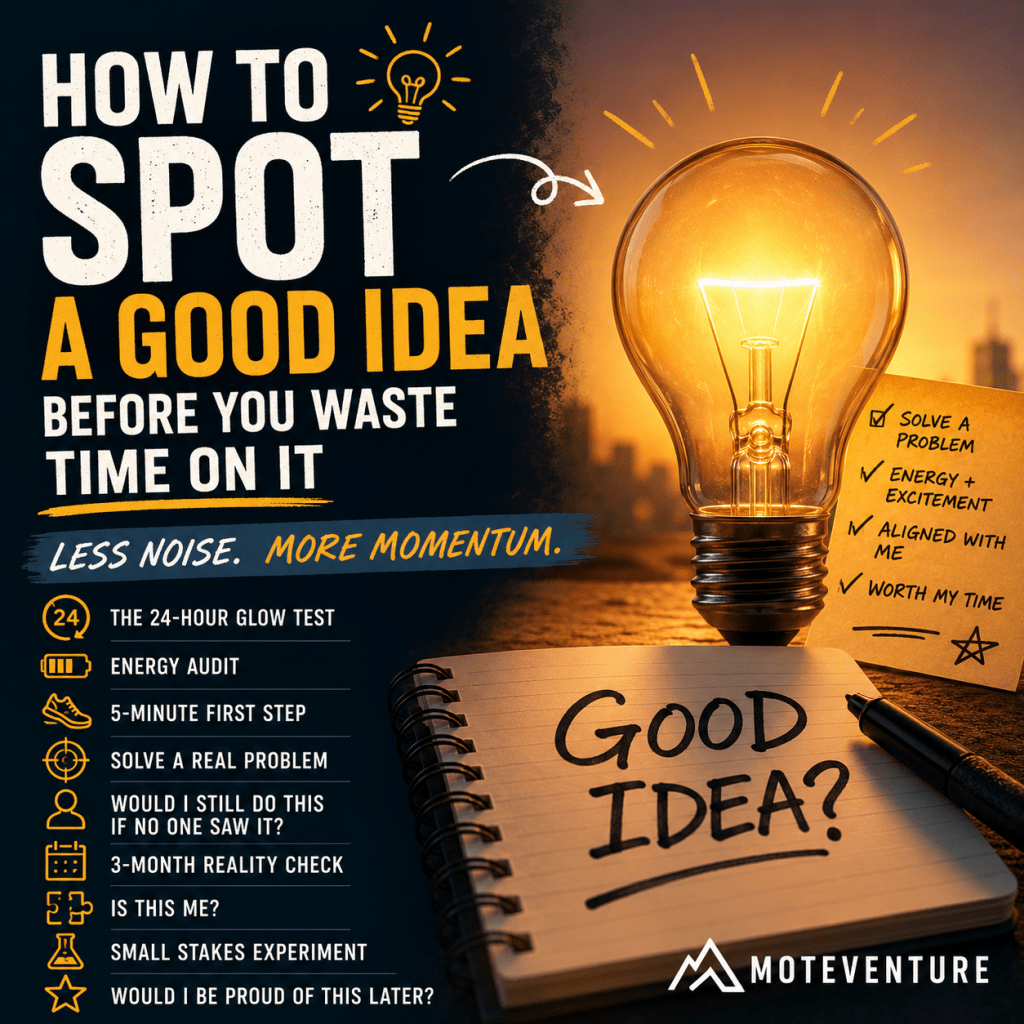
Some ideas arrive like lightning — loud, dramatic, impossible to ignore. Others sneak in quietly, tapping you on the shoulder like, “Hey… I might be something.” But here’s the truth no one likes to admit: not every idea deserves your time. And the fastest way to burn out is to chase every spark as if it’s a wildfire.
So today’s Saturday read is a simple one: How do you know which ideas are worth pursuing — and which ones should stay in the group chat?
Let’s break it down.
1. The 24‑Hour Glow Test
A great idea still feels great the next day. A mediocre idea evaporates like a dream you can’t quite remember. Give it a night. If it still has a pulse in the morning, keep it.
2. The “Would I Do This on a Tired Tuesday?” Check
Anyone can be inspired on a Saturday. But if the idea only sounds fun when you’re caffeinated, rested, and romanticizing your life… …it’s probably not built for the long haul.
3. The 5‑Minute First Step Rule
If you can’t identify a tiny, doable first action — a message, a sketch, a paragraph, a test — the idea might be too vague or too big. Good ideas have clear entry points.
4. The “Does This Solve a Real Problem?” Filter
Not every idea needs to change the world. But it should solve something: boredom, curiosity, frustration, a gap you’ve noticed. If you can’t name the problem, you can’t measure the payoff.
5. The Energy Audit
Some ideas drain you just by thinking about them. Others give you a weird, buzzing excitement — the kind that makes you sit up straighter. Follow the buzz. Ignore the drain.
6. The “Would I Still Do This If No One Saw It?” Question
This one stings. If the idea only exists for applause, likes, or validation, it won’t survive the quiet parts. The best ideas feel meaningful even in the dark.
7. The 3‑Month Reality Check
Imagine yourself three months into this idea. Are you energized? Or exhausted? Your future self is a better judge than your current enthusiasm.
8. The “Is This Me?” Alignment Test
A good idea fits your identity, your values, and your long‑term direction. A bad idea feels like wearing someone else’s jacket — cool, but not quite right.
9. The Small Stakes Experiment
Before you commit, run a tiny experiment. A prototype. A sample. A one‑day version. If the experiment feels promising, scale it. If not, you’ve saved yourself weeks.
10. The “Would I Be Proud of This Later?” Lens
Not perfect. Not viral. Not groundbreaking. Just proud. If the answer is yes, that’s a green light.
The Wrap‑Up
Ideas are cheap. Time is not. And the real skill isn’t generating more ideas — it’s learning to separate the sparks from the smoke.
When you know how to spot a good idea early, you save your energy for the things that actually move your life forward. And that’s the whole point: less noise, more momentum.


Hey there — I’m Jon. This is Moteventure, my corner of the internet where music, movies, lists, and life all collide. Glad you’re here.