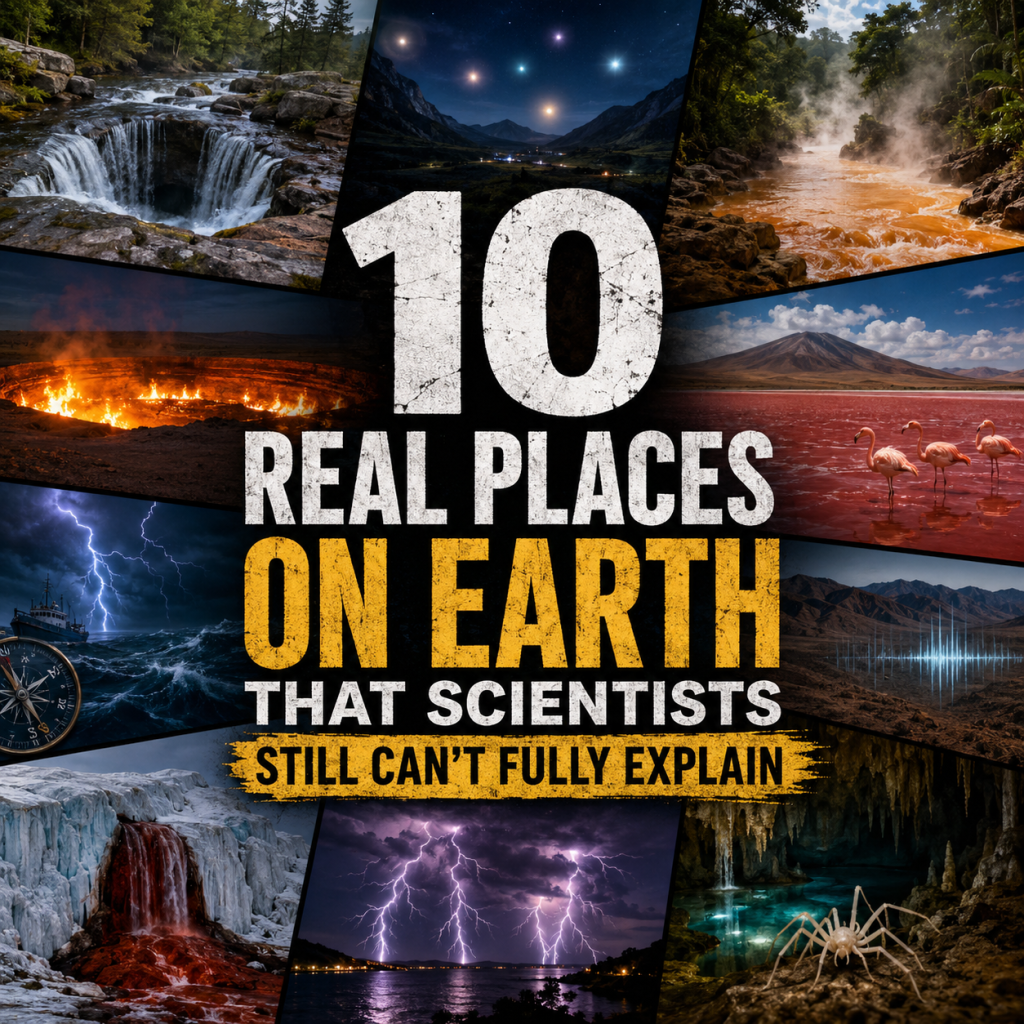
The world is mapped, measured, photographed, and pinned on Google Earth… yet somehow, a handful of places still refuse to give up their secrets. These aren’t myths or internet campfire stories — they’re real locations scientists have studied, debated, and in some cases, flat‑out can’t explain. If you love that feeling of “wait… how is this even possible?”, buckle up. These are the places that make even experts scratch their heads.
1️⃣ The Devil’s Kettle – Minnesota, USA
On the north shore of Lake Superior, the Brule River splits in two — one half flows normally, the other drops into a massive hole in the rock… and disappears. Scientists have dumped dye, ping‑pong balls, even GPS trackers into the Kettle. Nothing comes out downstream. The leading theory is that the water rejoins the river underground, but no one has ever proven it. It’s a geological magic trick happening in plain sight.
2️⃣ The Hessdalen Lights – Norway
Since the 1930s, glowing orbs have floated, darted, and hovered over this quiet valley. They’ve been captured on film, tracked by radar, and studied by universities. The lights can last seconds or hours, sometimes moving with eerie intelligence. Theories range from plasma to piezoelectricity to something we don’t have a name for yet. Whatever they are, they’re real — and they’re not going away.
3️⃣ The Boiling River – Peru
Deep in the Amazon lies a river so hot it can cook anything that falls into it. Temperatures reach nearly 200°F, and the nearest volcanic activity is hundreds of miles away. Local legends say the river is sacred; scientists say it shouldn’t exist. Yet it does — steaming, bubbling, and defying every geological rule in the book.
4️⃣ The Door to Hell – Turkmenistan
In 1971, a Soviet drilling operation accidentally collapsed into a natural gas cavern. To prevent toxic gas from spreading, they lit it on fire, expecting it to burn out in a few days. It’s been burning for over 50 years. The crater glows like a portal to another world, and no one knows how deep the gas reserves go — or when, if ever, it will stop.
5️⃣ Lake Natron – Tanzania
This blood‑red lake is so alkaline it can calcify animals into stone-like sculptures. Birds that misjudge their landing end up preserved like eerie art pieces. The water can reach a pH of 12 — similar to ammonia. Yet flamingos thrive here, nesting on the lake’s crusty surface. It’s a place where life and death coexist in the strangest balance.
6️⃣ The Bermuda Triangle – Atlantic Ocean
It’s the most famous mystery zone on Earth. Ships vanish. Planes disappear. Compasses go haywire. Weather patterns shift in minutes. Scientists have proposed everything from methane gas eruptions to rogue waves to magnetic anomalies. But no single explanation fits every disappearance. The Triangle remains a riddle wrapped in ocean fog.
7️⃣ The Taos Hum – New Mexico, USA
Imagine hearing a low, droning hum that no microphone can detect. That’s the reality for residents of Taos, who’ve reported the sound for decades. Some describe it as a distant engine; others say it feels more like a vibration than a noise. Studies have found no consistent source. It’s a sound that exists — but only for the people who hear it.
8️⃣ Blood Falls – Antarctica
From the side of a glacier, a waterfall of bright red water spills onto the ice. It looks like a horror movie prop, but it’s real — and ancient. The water comes from a trapped, oxygen‑free lake beneath the glacier, rich in iron that oxidizes on contact with air. The mystery? How the water still flows in one of the coldest places on Earth.
9️⃣ Catatumbo Lightning – Venezuela
At the mouth of the Catatumbo River, lightning storms rage up to 280 nights a year, sometimes flashing thousands of times per hour. No other place on Earth has a storm system this consistent. Scientists think it’s a perfect mix of humidity, wind, and topography — but even then, the intensity is unmatched. It’s nature’s own light show, running on a schedule no one fully understands.
🔟 Movile Cave – Romania
Sealed off from the outside world for 5.5 million years, this cave hosts an ecosystem unlike anything else on Earth. The air is toxic, the water is acidic, and the creatures — including blind spiders and unique worms — survive on chemosynthesis instead of sunlight. It’s a snapshot of what life might look like on another planet.
Mysteries like these remind us that the world is still bigger, stranger, and more unpredictable than we give it credit for. We like to think everything has an answer — but sometimes the planet throws us a curveball just to keep things interesting. Which one of these places pulled you in the hardest — and do you want a deep‑dive post on any of them next?


Hey there — I’m Jon. This is Moteventure, my corner of the internet where music, movies, lists, and life all collide. Glad you’re here.