The death of Iran’s Supreme Leader Ali Khamenei has sent a shockwave through the global political landscape. For nearly four decades, he ruled through fear, repression, and a vast security apparatus designed to silence dissent before it could take shape. His sudden removal from the world stage doesn’t just mark the end of an era for Iran—it reopens a timeless question about the nature of absolute power and the men who wield it.
History is filled with rulers who believed their authority was unshakable, their systems indestructible, and their legacies untouchable. Yet every dictatorship, no matter how fortified, eventually reaches a breaking point. Some collapse under the weight of their own brutality. Some are toppled by the people they oppressed. Others fall to foreign forces, internal betrayal, or the simple inevitability of mortality.
Moments like this—when a long‑standing dictator falls—invite us to look backward as much as forward. They remind us that tyranny has patterns, consequences, and endings. And they show that even the most feared regimes are not immune to history’s turning tide.
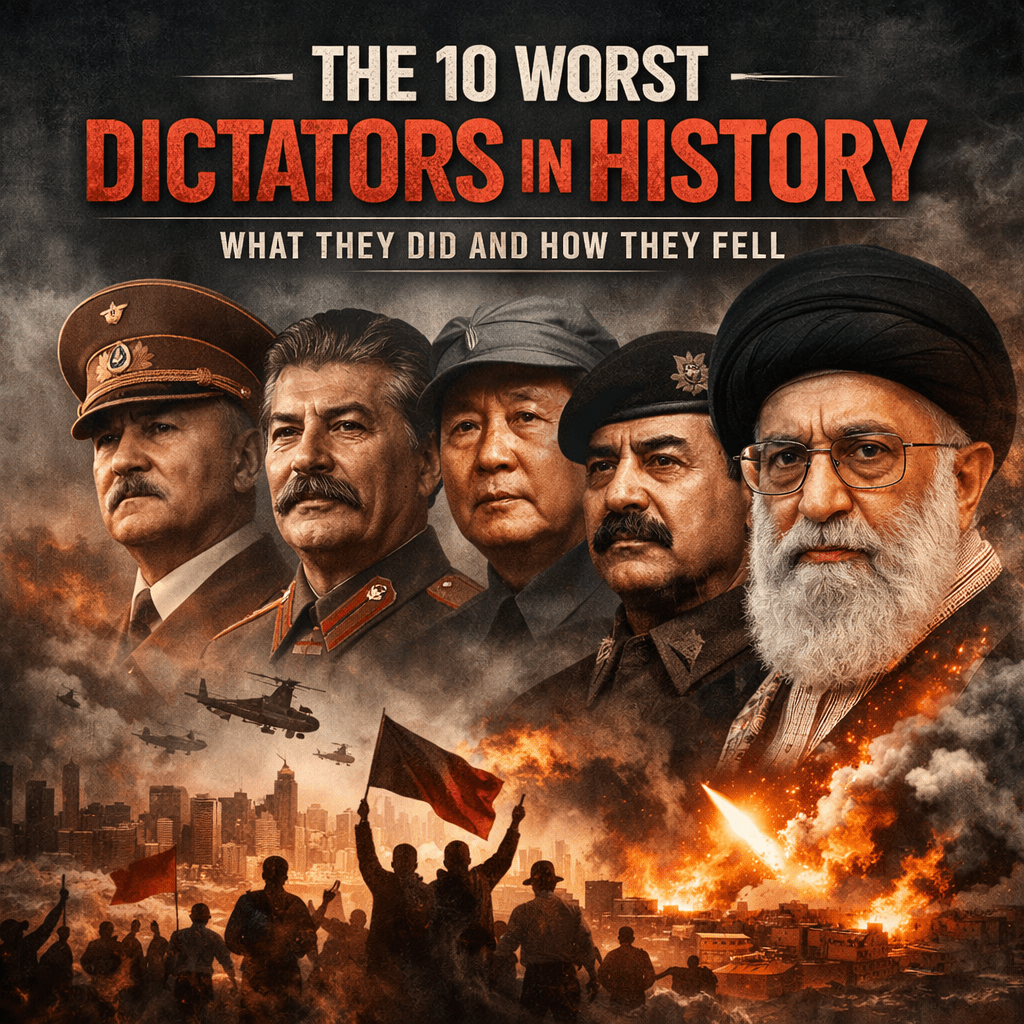
What follows is a look at ten of the most notorious dictators the world has ever known: what they did, how they maintained their grip on power, and the forces that finally brought them down.
1. Adolf Hitler (Germany)
Reign: 1933–1945
Crimes: Engineered the Holocaust, launched World War II, oversaw genocide, mass repression, and totalitarian control.
Downfall: As Allied forces closed in on Berlin, Hitler died by suicide in his bunker in April 1945.
2. Joseph Stalin (Soviet Union)
Reign: 1924–1953
Crimes: Purges, gulags, engineered famines, mass executions, and total state terror resulting in millions of deaths.
Downfall: Died of a stroke in 1953; his regime’s brutality was later partially exposed and denounced by his successors.
3. Mao Zedong (China)
Reign: 1949–1976
Crimes: The Great Leap Forward famine, Cultural Revolution purges, mass imprisonment, and ideological terror.
Downfall: Died of natural causes in 1976, leaving behind a devastated population and a fractured political system.
4. Pol Pot (Cambodia)
Reign: 1975–1979
Crimes: Led the Khmer Rouge genocide, killing nearly a quarter of Cambodia’s population through executions, starvation, and forced labor.
Downfall: Overthrown by a Vietnamese invasion; died under house arrest in 1998.
5. Saddam Hussein (Iraq)
Reign: 1979–2003
Crimes: Chemical attacks on civilians, mass executions, torture, political repression, and regional wars.
Downfall: Deposed by the U.S.-led invasion in 2003; captured, tried, and executed in 2006.
6. Benito Mussolini (Italy)
Reign: 1922–1943
Crimes: Fascist repression, political assassinations, colonial atrocities in Africa, and alliance with Nazi Germany.
Downfall: Overthrown by his own Grand Council, captured by partisans, and executed in 1945.
7. Idi Amin (Uganda)
Reign: 1971–1979
Crimes: Ethnic massacres, torture, disappearances, and economic collapse under a reign of terror.
Downfall: Fled into exile after being ousted by Tanzanian forces and Ugandan rebels; died in Saudi Arabia in 2003.
8. Kim Jong-il (North Korea)
Reign: 1994–2011
Crimes: Famine caused by state mismanagement, prison camps, executions, and total information control.
Downfall: Died of a heart attack in 2011; succeeded by his son Kim Jong-un, continuing the dynasty’s repression.
9. Muammar Gaddafi (Libya)
Reign: 1969–2011
Crimes: Torture, disappearances, mass killings, and brutal suppression of dissent over four decades.
Downfall: Overthrown during the Arab Spring; captured and killed by rebel forces in 2011.
10. Ali Khamenei (Iran)
Reign: 1989–2026
Crimes: Built a de facto military dictatorship, crushed dissent, oversaw mass executions, empowered the IRGC, and presided over violent crackdowns—including the January 2026 massacre that killed over 36,000 protesters.
Downfall: Killed in a targeted Israeli–U.S. airstrike on February 28, 2026, ending 37 years as Iran’s supreme leader.
Why These Falls Matter
The fall of dictators rarely comes cleanly, and almost never comes quickly. Each of the men on this list built systems designed to outlive them—networks of fear, propaganda, and violence meant to make their rule feel permanent. Yet history keeps proving that even the most entrenched regimes eventually fracture under the weight of their own brutality. Some collapse in a single uprising, some erode slowly from within, and some only end when death finally removes the figure holding everything together.
Khamenei’s death places Iran at one of those rare inflection points. It echoes the same pattern seen across eras: when a dictator falls, a nation is forced to confront both the wounds of the past and the possibilities of the future. What comes next is never guaranteed—some countries rise into freedom, others slip into new forms of repression—but the moment itself is always a reminder that absolute power is never as permanent as it pretends to be.
The stories of these ten dictators show that tyranny can dominate a generation, but it cannot escape history’s judgment. And when the moment of reckoning finally arrives, it often begins the same way it has now: with a sudden shift, a crack in the façade, and a nation standing at the threshold of change.

 MOTEVENTURE