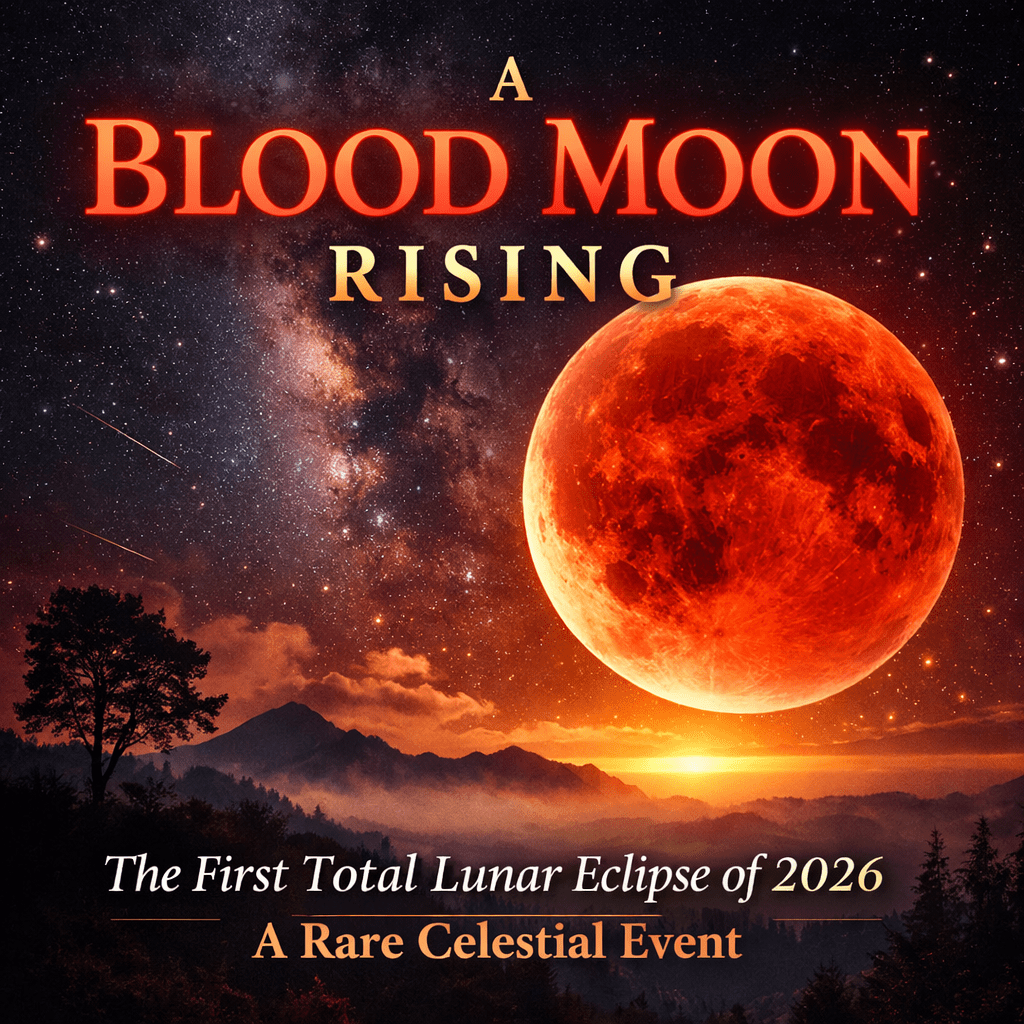
🌕 A Blood Moon Rising
Early this morning, the Moon slipped into Earth’s shadow, transforming into a deep red orb—what many call a Blood Moon. This happens during a total lunar eclipse, when sunlight bends through Earth’s atmosphere and paints the Moon in warm, coppery tones. Today’s eclipse is especially notable because it’s the first lunar eclipse of 2026 and the last total lunar eclipse anywhere on Earth until late 2028, making it a rare astronomical milestone.
For observers across North America and India, the timing aligned with early morning hours, creating a shared moment of wonder across continents. In India, the eclipse also intersects with cultural and religious traditions, occurring on a full moon and carrying significance for those who observe Sutak Kaal and other rituals tied to lunar events.
🔭 Why Today’s Eclipse Matters
A total lunar eclipse is more than a pretty sky show—it’s a convergence of science, culture, and history.
Scientific significance — Eclipses help researchers study Earth’s atmosphere. The shade of red the Moon takes on can reveal how much dust, ash, or pollution is currently suspended around the globe.
Cultural resonance — In many traditions, eclipses mark moments of reflection, cleansing, or spiritual awareness. Today’s event, landing near the Holi season in India, adds layers of meaning for millions.
Global connection — Unlike solar eclipses, lunar eclipses are visible across huge portions of the world. People separated by oceans can still share the same moment of awe.
🌍 A Moment in a Larger Story
Today’s eclipse also arrives during a news cycle filled with earthly tension—political primaries in Texas, debates in the U.S. Senate, and global security concerns. Yet for a few hours, the Moon offered a pause button. While headlines shift by the minute, celestial events remind us of the long arc of time and the rhythms that continue regardless of human conflict or uncertainty.
Even historically, March 3 carries weight. It’s a date remembered for pivotal moments—from civil rights flashpoints to cultural milestones—making today’s cosmic event feel like another chapter in a long-running story of change and reflection.
🌑 What Comes Next
After today, skywatchers will have to wait more than two years for another total lunar eclipse. Partial and penumbral eclipses will still dot the calendar, but none will offer the dramatic, cinematic transformation of a full Blood Moon until the end of 2028.
For now, though, today’s eclipse stands as a reminder that even in a world full of noise, there are still moments that pull us outside, tilt our heads upward, and reconnect us with something bigger.


Hey there — I’m Jon. This is Moteventure, my corner of the internet where music, movies, lists, and life all collide. Glad you’re here.