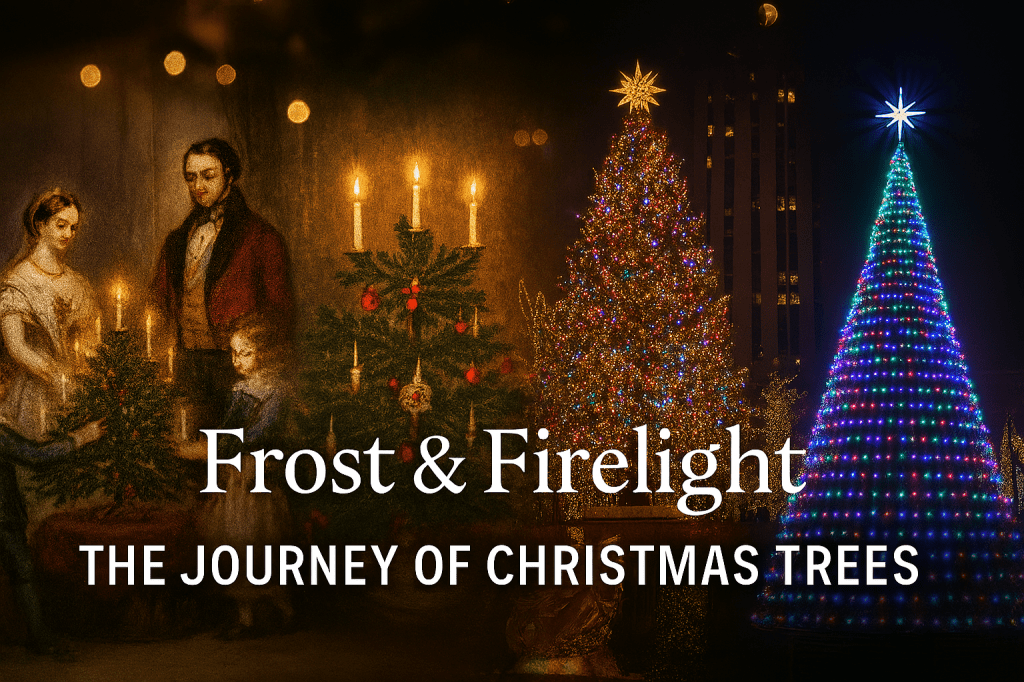
❄️✨Frost & Firelight: 25 Days of Christmas Wonders
This December, Moteventure turns its compass toward the glow of the season — where frost sharpens the air and firelight warms the heart. Frost & Firelight: 25 Days of Christmas Wonders is a daily storytelling journey through traditions, legends, and the mysteries that make the holidays shimmer. Each post is a marker along the path, a spark in the dark, where joy rises in familiar rituals and wonder flickers in unexpected tales. From dazzling lights to whispered folklore, these stories invite celebration, curiosity, and the shared magic of winter’s most luminous days.
Every season has its traditions. If Christmas wonder is a part of yours, leave a note beneath this post.
🎄 The Story of Christmas Trees: From Ancient Rituals to Modern Marvels
Few symbols capture the spirit of Christmas as vividly as the tree — glowing with lights, adorned with ornaments, and standing as the centerpiece of holiday gatherings. Yet the Christmas tree we know today has traveled a long, fascinating road, shaped by ancient rituals, royal influence, and modern innovation. Its story is one of resilience, adaptation, and enduring magic.
🌿 Ancient Evergreens: Symbols of Life in Winter
Long before Christianity, evergreen plants symbolized life and renewal during the darkest days of winter. Egyptians decorated their homes with palm fronds during the solstice, while Romans celebrated Saturnalia with evergreen boughs to honor Saturn, the god of agriculture. In Northern Europe, Druids revered evergreens as sacred, believing they warded off evil spirits. These traditions reflected hope that spring would return, making evergreens a powerful emblem of resilience against the cold and darkness.
🌿 Ancient Evergreens: Symbols of Life in Winter
The modern Christmas tree tradition is credited to Germany in the 16th century. Devout Christians began bringing decorated trees into their homes, often adorned with apples, nuts, and candles. Martin Luther is said to have added candles to a tree to recreate the beauty of starlight shining through evergreens on a winter’s night. These glowing trees became a symbol of divine light in the darkness, blending Christian faith with ancient symbolism. By the 17th century, Christmas trees were common in German households, though still considered unusual elsewhere.

✨ Support & Share my Version of a Christmas Carol!
A heartfelt holiday single from Moteventure — a ballad of longing, memory, and return.
Add it to your playlists, share it with friends, request it on your local radio station and let it soundtrack your season.
🎧 Save. 💌 Share. 🎄 Play.
👑 Royal Influence: From Palaces to Parlors
Christmas trees spread to England in the 19th century, largely thanks to Queen Victoria and Prince Albert. Albert, of German heritage, introduced the custom to the royal household. In 1848, an illustration of the royal family gathered around a decorated tree was published in the Illustrated London News. The image captivated the public, and soon Christmas trees became fashionable across Britain. The trend quickly crossed the Atlantic, influencing American families who admired Victorian traditions. What was once a regional custom became a global phenomenon.
🇺🇸 America Adopts the Tree
German immigrants had brought the tradition to Pennsylvania in the 1700s, but it wasn’t until the mid-1800s that Christmas trees gained widespread acceptance in the U.S. At first, Puritan communities resisted, viewing them as pagan symbols. But by the late 19th century, ornaments, tinsel, and electric lights transformed trees into dazzling displays. The annual Rockefeller Center tree lighting, begun in 1931 during the Great Depression, cemented the tree as a national icon of hope and unity. Today, millions watch the lighting ceremony, a tradition that continues to inspire awe.

🔥Ignite the Fire: Deluxe Edition is streaming on all platforms NOW! 🔥
Featuring 4 new tracks: Emberwake, Flat Tire, What If You’re Wrong, and the heartwarming holiday single Home For Christmas.
Take a moment to save it, playlist it and share it with anyone who loves a variety of genres of music in one place.
🎄 Artificial Innovations: Feather, Aluminum, and Beyond
Not all Christmas trees are natural. In the 19th century, Germans crafted feather trees from dyed goose feathers, designed to mimic evergreens while protecting forests. By the mid-20th century, aluminum trees became popular in America, shimmering under rotating color-wheel lights. These futuristic designs reflected mid-century optimism and modernity. Today, artificial trees range from hyper-realistic replicas to avant-garde designs, offering convenience, sustainability, and creativity. Some families even rent living trees, returning them to nurseries after the season to reduce waste.
🌍 Global Traditions: Local Flavors of the Tree
Christmas trees now appear worldwide, often adapted to local culture. In Japan, they’re decorated with origami cranes symbolizing peace. In Ukraine, spider-web ornaments are hung to bring good luck, inspired by a folk tale of a poor widow whose tree was magically decorated by spiders. In Mexico, trees are often adorned with handmade ornaments and bright ribbons. Norway annually gifts a towering spruce to London’s Trafalgar Square as a gesture of gratitude for Britain’s support during WWII. Each variation reflects the blending of tradition, identity, and cultural storytelling.
✨ Modern Marvels: Technology Meets Tradition
Today’s trees are more diverse than ever. LED-lit smart trees can be programmed to change colors and patterns. Eco-friendly options include trees made from recycled materials or living trees rented for the season. Upside-down trees, once used in medieval Europe to symbolize the Trinity, have returned as avant-garde décor. Even minimalist designs — bare branches adorned with lights — capture the essence of the season. Yet at their core, all these innovations echo the ancient meaning of evergreens: light, hope, and togetherness in the darkest time of year.
🎬 Closing Reflection
From pagan solstice rituals to global spectacles, the Christmas tree has evolved into a universal emblem of joy. Its journey reflects humanity’s enduring desire to bring light into darkness, to celebrate life amid winter’s chill, and to gather around symbols of hope. Whether real or artificial, candlelit or electric, the Christmas tree remains a living tradition — one that continues to grow, adapt, and inspire across generations.
If these stories have sparked something in you — a flicker of wonder, a burst of nostalgia, or a new curiosity about the season — consider subscribing to Frost & Firelight: 25 Days of Christmas Wonders and Moteventure. You’ll receive each new entry directly, and help us grow a community built on celebration, storytelling, and the shared magic of winter’s most luminous days.

 MOTEVENTURE