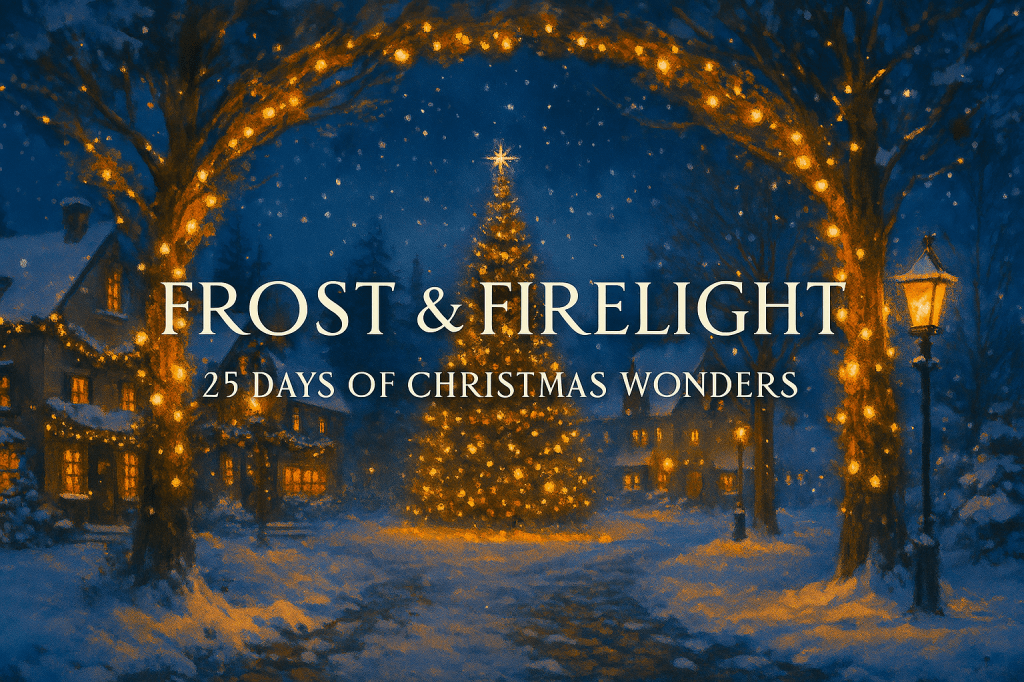
❄️✨Frost & Firelight: 25 Days of Christmas Wonders
This December, Moteventure turns its compass toward the glow of the season — where frost sharpens the air and firelight warms the heart. Frost & Firelight: 25 Days of Christmas Wonders is a daily storytelling journey through traditions, legends, and the mysteries that make the holidays shimmer. Each post is a marker along the path, a spark in the dark, where joy rises in familiar rituals and wonder flickers in unexpected tales. From dazzling lights to whispered folklore, these stories invite celebration, curiosity, and the shared magic of winter’s most luminous days.
Every season has its traditions. If Christmas wonder is a part of yours, leave a note beneath this post.
Christmas Lights Across America — From Small Town Streets to Dazzling Spectacles
When December arrives, darkness falls early across the United States. Yet as the sun slips below the horizon, neighborhoods, towns, and cities burst into life. Strings of lights drape across rooftops, glowing reindeer leap across lawns, and entire streets transform into rivers of color. Christmas lights are more than decoration; they are a shared language of joy, a way communities signal that the season has arrived.
But behind the sparkle lies a fascinating story — one of invention, tradition, and even a few mysteries. From Thomas Edison’s first electric bulbs to the sprawling displays of today, America’s love affair with Christmas lights is both deeply personal and spectacularly public.

✨ Support & Share my Christmas Single!
A heartfelt holiday single from Moteventure — a ballad of longing, memory, and return.
Add it to your playlists, share it with friends, request it on your local radio station and let it soundtrack your season.
🎧 Save. 💌 Share. 🎄 Play.
The Spark That Started It All
The tradition of Christmas lights began humbly. In the 17th and 18th centuries, families placed candles in windows to symbolize hospitality and welcome. It was dangerous, of course — open flames near pine boughs often led to fires. Enter Thomas Edison. In 1880, Edison strung electric lights outside his laboratory in Menlo Park, New Jersey, as a demonstration of his new invention. Two years later, his colleague Edward Johnson displayed the first electrically lit Christmas tree in New York City, with 80 red, white, and blue bulbs.
What began as a novelty quickly became a national obsession. By the 1920s, electric lights were mass-produced and affordable, spreading from department store windows to suburban homes. The glow of Christmas became a symbol of modernity, safety, and celebration.
Neighborhood Traditions
Across the country, neighborhoods have turned Christmas lights into community rituals. In Dyker Heights, Brooklyn, residents compete to outdo one another with extravagant displays — towering nutcrackers, animatronic Santas, and millions of bulbs. Crowds flock to see the spectacle, transforming quiet streets into a seasonal carnival.
In Des Moines, Iowa, families drive through neighborhoods where houses coordinate themes — one block might feature synchronized music, another a glowing archway of candy canes. These traditions are not just about decoration; they are about belonging. Each lit house contributes to a collective tapestry of joy.

Featuring 4 new tracks: Emberwake, Flat Tire, What If You’re Wrong, and the heartwarming holiday single Home For Christmas. Take a moment to save it, playlist it and share it with anyone who loves a variety of genres of music in one place.
The Mystery of the Lights
While most displays are joyful, some carry a hint of mystery. In certain towns, unexplained lights appear in the sky during December, sparking speculation. The “Marfa Lights” in Texas, for example, are glowing orbs that dance on the horizon. Though not strictly tied to Christmas, they often draw crowds during holiday visits. Scientists suggest atmospheric reflections, but locals whisper of spirits or visitors from beyond.
Even in suburban neighborhoods, mystery lingers. Why do some families devote entire fortunes to displays that rival amusement parks? What drives the compulsion to outshine the neighbors? Sociologists suggest it’s part competition, part tradition, and part yearning for wonder. Whatever the reason, the mystery only adds to the magic.
Iconic Displays
Some American light displays have become landmarks in their own right:
- Rockefeller Center, New York City: The towering tree, adorned with thousands of lights, is broadcast nationwide. It is less a decoration than a symbol of collective celebration.
- Disney World’s Holiday Spectacle, Florida: Entire streets are choreographed with synchronized lights and music, creating immersive experiences.
- McAdenville, North Carolina: Known as “Christmas Town USA,” nearly every home participates, turning the entire town into a glowing wonderland.
- Las Vegas Motor Speedway, Nevada: A drive-through display with millions of lights, blending holiday cheer with desert spectacle.
These displays are not just local traditions; they are destinations, drawing visitors from across the country.
Lights as Storytelling
Christmas lights are more than decoration — they are narrative devices. A single string of white bulbs can evoke elegance, while multicolored strands suggest playfulness. Inflatable figures tell stories of Santa’s journey, while synchronized shows transform homes into stages.
In some towns, lights are used to honor history. Veterans’ memorials glow red, white, and blue. Churches create nativity scenes illuminated by soft halos. Even businesses join in, using lights to signal community spirit rather than commerce. Each bulb becomes part of a larger story, weaving joy into the fabric of daily life.
The Joy of the Drive
One of the most beloved traditions is the evening drive. Families pile into cars, sip hot cocoa, and slowly cruise through neighborhoods. Children press faces to windows, marveling at glowing snowmen and shimmering icicles. The drive is not about speed; it is about savoring.
In rural areas, the drive becomes a pilgrimage. Farms string lights across barns, and small towns create glowing arches over main streets. The journey itself becomes part of the celebration, a reminder that joy can be found not only at home but in the shared spectacle of community.
Technology and Transformation
Modern technology has transformed Christmas lights into art. LED bulbs allow for dazzling colors and energy efficiency. Programmable systems synchronize lights with music, creating shows that rival professional productions. Some enthusiasts spend months coding sequences, turning their homes into living theaters.
Social media amplifies the spectacle. Videos of extraordinary displays go viral, inspiring others to experiment. Entire online communities share tips, designs, and tutorials. What was once a local tradition has become a national conversation, connecting decorators from coast to coast.
A Season of Light
Ultimately, Christmas lights are about joy. They pierce the darkness of winter, offering warmth and wonder. They remind us that celebration is not confined to grand halls or famous landmarks; it is found in the glow of a single bulb on a quiet street.
The mystery of why we are drawn to lights — whether unexplained or simply extravagant — only deepens their allure. Perhaps it is because light itself feels miraculous, a defiance of darkness. Or perhaps it is because, in the end, we all crave a little magic.
As December unfolds, America becomes a canvas of illumination. From the smallest candle in a window to the grandest display in Rockefeller Center, each light contributes to a season defined not by shadows, but by brilliance.

If these stories have sparked something in you — a flicker of wonder, a burst of nostalgia, or a new curiosity about the season — consider subscribing to Frost & Firelight: 25 Days of Christmas Wonders and Moteventure. You’ll receive each new entry directly, and help us grow a community built on celebration, storytelling, and the shared magic of winter’s most luminous days.

 MOTEVENTURE