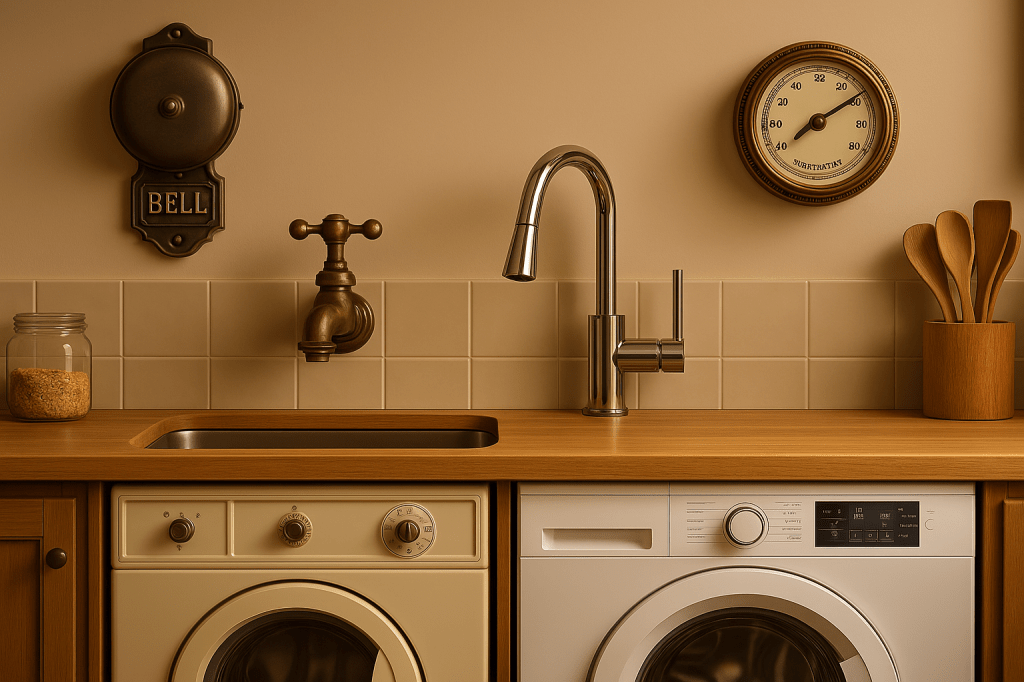
We twist a faucet, ring a doorbell, and step into a warm shower with zero fanfare—but these small comforts have surprisingly rich backstories. Join us as we travel back in time to uncover the ingenious inventions and cultural twists that gave rise to some of the most unassuming modern marvels in our homes today.
🚿 The Shower: A Splash of Ancient Innovation
The ancient Greeks were early adopters, using aqueducts to feed public bathing systems with rudimentary shower-like devices. But the first true mechanical shower came in 1767, patented in England by William Feetham. These early contraptions were clunky and often lacked hot water—luxury took its time arriving.
🔔 The Doorbell: From Knock Knock to Ding Dong
Door knockers were once the only way to announce oneself. Then in the 1830s, mechanical doorbells began to ring their way into homes. By the 1850s, electric versions became possible as home wiring spread. Now, smart doorbells let us monitor, record, and even talk to guests—or pesky raccoons—in real time.
🚰 The Faucet: From Roman Ingenuity to Everyday Ease
While Romans mastered aqueducts and public fountains, home faucets took a while. It wasn’t until 1937 that Al Moen patented the single-handle faucet, inspired by a scalding accident. Since then, we’ve seen leaps in water efficiency, sensor activation, and sleek design.
🚽 Toilet
Roman public latrines were communal—and lacked privacy. The first flushable toilet concept was sketched by Sir John Harington in 1596, but widespread adoption didn’t come until the 1800s, helped along by Victorian-era sanitation reforms and Thomas Crapper’s plumbing company. Yes, really.
⚡ Light Switch
Before switches, lights were activated with pull cords or even by plugging and unplugging power cords. The toggle light switch as we know it was introduced in the early 20th century, making lighting safer and far more intuitive.
🍽️ Microwave Oven
Accidentally invented in the 1940s when engineer Percy Spencer noticed a melted candy bar in his pocket near radar equipment, the microwave began as an industrial-sized behemoth before shrinking into a kitchen must-have by the 1980s.
🧹 Vacuum Cleaner
Before cordless convenience, the first powered vacuums were horse-drawn machines parked outside homes in the early 1900s, using hoses fed through windows. Home versions, like Hoover’s electric cleaners, revolutionized household cleanliness starting in the 1920s.
🧺 Washing Machine
It all began with scrubbing on washboards. The first automatic washing machines appeared in the 1900s, but it wasn’t until post-WWII domestic booms that they became common. Agitator, spin cycles, and energy-efficient models followed.
🌡️ Thermostat
Once a manual labor of stoking fires, the first programmable thermostats emerged in the 1900s, with Honeywell playing a key role in making indoor climate control the year-round comfort zone we now expect.
🪟 Curtains
Long before interior designers made them stylish, ancient people used animal hides or textiles to block light and maintain warmth. Over centuries, curtains evolved into not just practical shields, but powerful status symbols.
⏰ Clock
From sundials to towering church clocks, timekeeping evolved over millennia. Personal alarm clocks didn’t hit the scene until the 19th century, and now they’ve all but merged with our phones and smart assistants.
🛏️ Bed
Raised sleeping platforms date back to ancient Egypt, designed to avoid pests and show off status. Feathers, hay, horsehair, springs, memory foam—it’s all part of the dream evolution of sleep technology.
💡 Final Thoughts: The Marvel in the Mundane
The things we touch every day—often without a second thought—are the result of centuries of innovation, trial and error, and cultural shifts. They’re reminders that progress is always happening, even in the smallest, quietest corners of our lives.
Next time you flip a switch, fluff your pillow, or nuke your lunch—know that you’re living in the future someone once only imagined.

 MOTEVENTURE